



Risk notice. No strategy, website or author can guarantee a win, a profit or a particular gambling result. This guide deals exclusively with spending, exposure and risk. It provides no instructions for winning or recovering losses. The modeled bankroll and limits illustrate decisions about spending, and losses remain possible.
What you risk in a single round
The full amount of one accepted stake is exposed each time you play. The game debits it once, then every Go decision continues that same round. A safe step opens a choice between taking the available payout and carrying the stake into the next crossing. The client has one active stake per round and the ordinary round has no active Bonus Buy.
What happens at the Hard 3 target
At Hard 3 in the 95.5% profile, the multiplier is 1.83×. The model divides 0.955 by 1.83 to get a 52.1858% chance of reaching the fixed target, with 47.8142% for a stop before it. On a hypothetical 1 PLN stake, a confirmed cashout at that target returns 1.83 PLN gross, or 0.83 PLN net. A collision before the target costs the full 1 PLN. Those two outcomes together give an expected gross of 0.955 PLN and an expected net of −0.045 PLN per 1 PLN staked before cap and rounding.
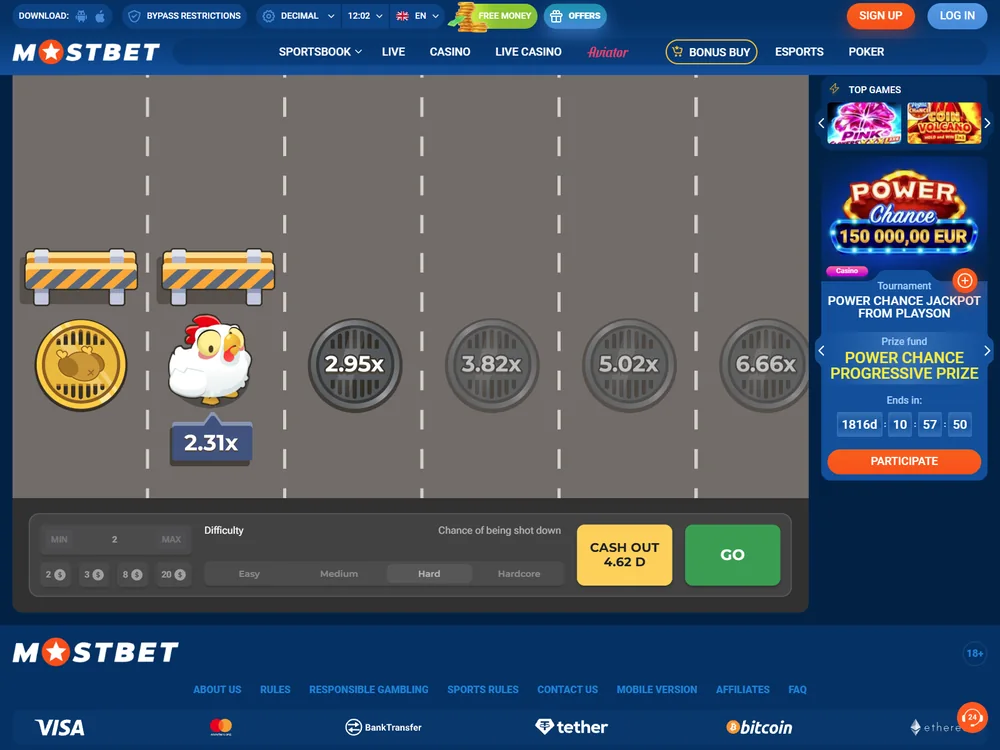
The payout includes the returned stake. That detail explains why reaching the target slightly more than half the time still produces a negative expected net: the amount gained on a cashout is smaller than the amount lost on a collision. Session results fluctuate around the underlying expectation, especially when the stake changes from round to round.
The 95.5%, 97% and 98% RTP profiles are separate launch configurations. For Hard 3, the 97% profile uses 1.84× and a modeled target probability of 52.72%. The 98% profile uses 1.86× and 52.69%. At equal turnover of 100 PLN, the respective expected losses before cap and rounding are 3.00 PLN and 2.00 PLN. Select the difficulty before Play. Easy, Medium, Hard and Hardcore have 30, 25, 22 and 18 lanes in Chicken Road 2.0, and the assigned RTP profile stays in place across those four settings. See the RTP and multiplier guide for the underlying calculation.
How cashout and payout caps work
The server fixes the payout when it accepts Cash out after a safe step. The credited gross is the stake times the accepted multiplier, limited by the round cap and then rounded to 0.01 in the wallet currency. Intermediate amounts shown during a round are alternatives for that one stake. If a collision occurs before cashout is confirmed, the payout is zero. Reaching the field limit also ends the round. Any payout appears in the gaming balance. A withdrawal to a payment method requires a separate operator request. The game rules cover the full round sequence.
The official USD demo uses virtual stakes between 0.12 and 200 USD with a 20,000 USD per-round payout cap. At a 3 USD stake, the cap starts to matter above 6,666.6667×. The last Hardcore lane in the 95.5% profile shows 3,608,855.25×, which would yield 10,826,565.75 USD before the cap. The credited amount would be 20,000 USD in that demo. For a capped target, expected gross is the target probability multiplied by the capped payout. Subtract the original stake to get expected net.

For readers in Poland, the PLN amounts in the model are illustrative. The observed Poland wallet profiles had different ranges and caps. NV Casino showed 0.55–56.00 PLN with a 24,500 PLN cap, Total Casino 0.60–62.25 PLN with a 23,250 PLN cap, and Ice Casino 0.64–56.75 PLN with a 26,875 PLN cap. The Mostbet Poland profile used EUR, with a stake range of 0.41–35.75 EUR and a 13,750 EUR cap. Money mode was closed from Poland in the Stake and Bison profiles.
Two separate Finnish profiles illustrate why the account context matters. 22bet showed 0.32–36.75 EUR with a 13,625 EUR cap, and Bitguruz showed 0.21–35.25 EUR with an 11,750 EUR cap. Treat each range as a setting for that profile and currency. The examples establish the difference a wallet configuration can make to round exposure.
How Chicken Road 2.0 strategies compare
Every policy faced the same Hard 3 target. What changed was the amount staked after an outcome, or how soon the policy left the session. That common setup makes it possible to compare turnover, average net, downside and the frequency of crossing the loss boundary.
The assumptions shared by all eight policies
Each policy ran through 12,000 simulated sessions using common random numbers across the policies and independent outcomes within the model. Every session started with 100 PLN and could run for up to 80 cycles. The target used a 52.19% probability and a 1.83× multiplier. Stakes ran in increments of 0.01 PLN, with payouts rounded to the grosz.
The model checked the −30 PLN stop-loss and +30 PLN take-profit boundaries after the round settled. A pending round had to settle before that check. If the next stake exceeded the available balance, the model reduced it to the remaining amount. It stopped the session if the balance fell below 0.50 PLN. The pause-and-stop policy also ended the session after four consecutive collisions.
Mean results, downside and stop-loss frequency
All eight mean net results were negative. The table shows net outcomes and standard errors in PLN. Turnover counts the amount staked over the session, so the same funds can contribute more than once when they are returned and staked again.
| Policy | Stake rule, PLN | Mean turnover | Mean net | P05 / P50 / P95 net | SE of mean | Stop-loss |
|---|---|---|---|---|---|---|
| Fixed stake | 2.00 each round | 153.29 | −6.95 | −31.14 / −6.28 / 19.34 | 0.14 | 12.43% |
| Bankroll share | 2% of balance, minimum 0.50 and maximum 12.00 | 150.00 | −6.78 | −30.37 / −7.36 / 24.20 | 0.14 | 7.59% |
| Linear increase | Start at 2.00, add 1.00 after a loss, reset to 2.00 after cashout | 186.28 | −8.54 | −35.35 / −8.89 / 30.49 | 0.20 | 34.10% |
| Geometric increase | Start at 2.00, double after a loss, reset to 2.00 after cashout | 183.92 | −8.65 | −40.14 / −30.42 / 31.22 | 0.27 | 52.63% |
| Loss recovery | Base 2.00, increase up to 12.00 in an attempt to cover the losing sequence | 180.22 | −8.43 | −40.18 / −14.40 / 31.60 | 0.25 | 48.05% |
| Increase after a payout | Start at 2.00, add 0.50 after a payout up to 12.00, reset to 2.00 after a collision | 179.13 | −8.07 | −31.36 / −10.69 / 31.66 | 0.18 | 23.88% |
| Reset after two payouts | Start at 2.00, add 0.50 after a payout, reset after two payouts or a collision | 163.07 | −7.34 | −31.18 / −8.32 / 24.06 | 0.16 | 16.62% |
| Pause and stop | 2.00 each round, stop after four consecutive collisions | 62.12 | −2.97 | −14.68 / −5.02 / 15.54 | 0.08 | 0.09% |
P05, P50 and P95 are the fifth percentile, median and 95th percentile of the session results. Approximately 5% of results fall at or below P05. For the geometric policy, the median loss was 30.42 PLN and the fifth-percentile loss was 40.14 PLN. The two values show why the mean alone gives an incomplete view of downside. SE measures the precision of the simulated mean. A small SE can still accompany a wide range of results for individual sessions.
The fixed-stake policy reached the loss boundary in 12.43% of runs. Doubling reached it in 52.63% of runs, even though both used the same target multiplier and probability. The bankroll-share policy reached it in 7.59%. It stakes less as the balance falls until the minimum stake applies, which changes how losses build up. The pause-and-stop policy had the lowest average turnover, at 62.12 PLN, and the smallest average loss, at 2.97 PLN.
The frequency of a balance below 0.50 PLN was 0.00% for all eight policies in these runs. The shared stop-loss rule could end a session well before the bankroll was exhausted. A loss threshold can still be crossed by the final settled bet, as figures below −30 PLN in the table show. The upper threshold can also be crossed on the last settlement. Use the results to compare exposure under these assumptions. A small sample of successful cashouts leaves out the outcome distribution that matters here. See how to evaluate signals and predictor claims.
Where to play Chicken Road 2.0
Compare six operator profiles. The scores reflect the routes tested for Chicken Road 2.0. Check authorisation in Poland and your account’s eligibility before depositing.
NV Casino

Cash test in PLN
- All 6 accepted rounds settled.
- Tested Visa deposit limits were 45.50–800 PLN.
- Withdrawals to a personal Visa started at 50 PLN.
Stake

Poland restriction
- Terms §14.3 exclude Poland.
- No cash bets were accepted in the Polish account.
- The 63 PLN transfer was still under review at the end of the test.
Total Casino

Signed-in PLN test
- All 5 accepted rounds settled.
- Public search found no exact InOut title.
- Tested BLIK deposit limits were 10–600 PLN.
Ice Casino

Cash test in PLN
- 5 of 6 accepted rounds settled. One was voided.
- Tested Skrill deposit limits were 40.50–700 PLN.
- The demo opened from the operator’s own game listing.
Bison Casino

Poland restriction
- The eligibility prompt required access from outside Poland.
- The virtual demo ran separately from the cash account.
- The 79.15 PLN BLIK payment was still under review at the end of the test.
Mostbet

Cash test in EUR
- All 7 accepted rounds settled in the EUR wallet.
- Standard Chicken Road 2.0 was listed as card 123628.
- Tested Mastercard deposit limits were 18.25–390 EUR.
How doubling changes the next stake
After three consecutive losses at 2, 4 and 8 PLN, the next full stake in a doubling sequence is 16 PLN. The three settled bets have already cost 14 PLN, so the fourth stake exposes another 16 PLN from the remaining bankroll. If the session started with 100 PLN and there were no earlier bets, a fourth consecutive loss reaches the model’s stop-loss after settlement.
Consecutive losses and the remaining bankroll
The table assumes losses from a starting balance of 100 PLN and shows the nominal ladder, including its unfunded final row. The balance column shows what would follow the specified loss. In the simulation, the stop rule ends a session that starts with these four losses immediately after the fourth settles.
| Attempt | Full stake, PLN | Cumulative loss if all bets lose, PLN | Balance after the loss, PLN | Funding and stop condition |
|---|---|---|---|---|
| 1 | 2.00 | 2.00 | 98.00 | Bankroll covers the stake |
| 2 | 4.00 | 6.00 | 94.00 | Bankroll covers the stake |
| 3 | 8.00 | 14.00 | 86.00 | Bankroll covers the stake |
| 4 | 16.00 | 30.00 | 70.00 | Settlement hits the model stop-loss |
| 5 | 32.00 | 62.00 | 38.00 | Hypothetical continuation without that stop |
| 6 | 64.00 | 126.00 | −26.00 nominal | The full stake exceeds the remaining 38.00 PLN |
A drawdown measures how far the balance has fallen from its previous peak. Final net measures the change from the opening balance when play ends. After an early gain, a session can suffer a drawdown while its final net is still positive. In the doubling example, the first four losses occur from the opening peak, so the drawdown at that point is 30 PLN and the closing balance under the model rule is 70 PLN.
How time limits change turnover
A time limit can lower turnover by leaving fewer opportunities to place a bet. For Chicken Road 2.0 strategies, risk management starts by keeping the starting budget, turnover and worst acceptable loss separate. Even a small fixed stake can lead to turnover above the original budget when returned funds are staked again.
A 15-minute example in PLN
Allow 3 minutes of pauses inside a 15-minute period. That leaves 720 seconds, or 80 available cycles if a full cycle takes 9 seconds. At 75% participation, 60 stakes of 2 PLN generate 120 PLN of turnover. At 95.5% RTP, the expected loss on that turnover is 5.40 PLN before any cap or rounding effects. The 60 stakes are an assumption for the pace example. Actual cycle length, skipped rounds or an earlier stop can change the number of bets.
How to check your exposure
Check a virtual round before using any of the PLN examples to interpret a balance.
- In the virtual demo, check the stake, selected difficulty and wallet unit before pressing Play.
- After a safe step, use Cash out if you want to see how a payout is fixed. Wait for settlement and open My bet history. Check the bet, multiplier and credited amount.
If you want to check a session total, work from settled entries.
- Add the settled stakes to get turnover. Record void refunds separately and leave pending entries out until they settle.
- Subtract the turnover from settled gross to get net. Compare the net with the loss boundary after the current round settles.
In a Polish NV Casino session, I staked 3.55 PLN and cashed out at Hard 2, with an accepted multiplier of 1.46× and a gross credit of 5.18 PLN. The balance moved from 91.65 PLN after the debit to 96.83 PLN after settlement. Across that session, four of six settled bets paid out, with 22.37 PLN in turnover and 10.91 PLN net. The 95% Wilson interval for the payout proportion runs from 30.00% to 90.32%, reflecting how much uncertainty remains in a sample of six. In the Ice Casino session, a void stake of 4.60 PLN was refunded and excluded from settled turnover.
What a staking policy can change
Stake size and stop conditions change the amount exposed and the distribution of session results. Doubling increases exposure after losses, while pauses reduce turnover when they result in fewer overall bets. The expected loss per unit of turnover stays the same at the same target and configuration before cap and rounding. Use the demo to understand the controls. For account limits, time-outs, self-exclusion and support, see responsible gambling and help.
Frequently asked questions
Can a Chicken Road 2.0 strategy guarantee a profit?
No. Each of the eight modeled staking policies produced a negative average net at the same Hard 3 target. Individual sessions can finish with a gain or a loss.
Does a 30 PLN stop-loss cap every session loss at 30 PLN?
No. The model checks the threshold after the current bet settles. If the last stake takes net losses beyond 30 PLN, the session ends at that settled result.
Can doubling recover every losing streak?
No. Each loss increases the next nominal stake. The balance, a stop rule or an applicable stake limit can end the sequence. The amount returned on a cashout also depends on the accepted multiplier.
Does playing fewer rounds change the house edge?
Fewer rounds can reduce turnover. At the same stake conditions and fixed target, the expected loss per unit of turnover stays unchanged before cap and rounding.

Author
Publisher information
Chicken Road is an informational website published by Michał Kowalski. Casino operators manage player accounts, accept wagers and process deposits and withdrawals.
Play responsibly
18+. Gambling can cause financial and personal harm. Set limits on time and spending before you play. For support, see GamCare and GambleAware.