


Chicken Road: how to play one paid round
You choose the stake and difficulty before Play. Once the game accepts the bet, that single stake covers the road until the round closes. InOut Games released this version on 15 April 2025. Its game mode is chicken-road-two, and 1.0.0 identifies the rules panel in the client described here.
Set your stake and difficulty before Play
Open Game rules and check the currency, minimum, maximum and Max win for the game you have launched. If you are playing from Poland, check the actual wallet currency even when the surrounding site is in Polish. The PLN examples below come from particular wallets. The Mostbet session in Poland used EUR.
Enter the stake manually or use MIN, MAX or a quick amount. The USD demo offers quick amounts of 2, 3, 8 and 20 USD. Those buttons select amounts within the range shown in Game rules. After you choose the stake, select Easy, Medium, Hard or Hardcore before you send Play. The setting changes the road for the next round.
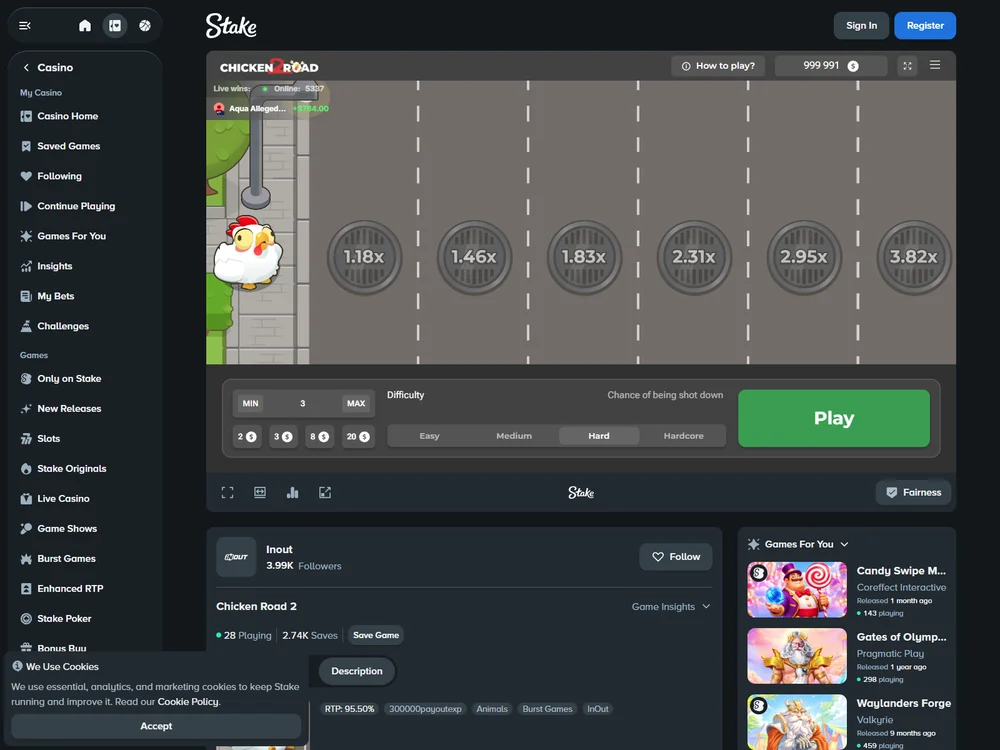
The single-player board has one paid position. Your stake buys the entire attempt, and the car and chicken show where it stands. The client answers two practical questions about Chicken Road: how to play the round and what limits apply. Open How to play? for the controls and Game rules for the amounts. Check both before you use a cash wallet.
How to play Chicken Road 2.0 step by step
Send Play once. The game opens the paid round when it accepts the stake.
- Choose the amount and difficulty. Read the stake next to Play, especially after selecting a quick amount or leaving the demo. Check the currency and amount before selecting Play.
- Select Play and check the response. An accepted request commits the stake once. If the game rejects the request, the rejected request makes no debit. You can stop the submission before the game accepts it, and an accepted bet closes through settlement or a confirmed void. The next Play can start a new round once the current one closes.
- Read the safe position before choosing an action. Once the game confirms a crossing, it shows the applicable multiplier and possible payout for that position.
- Choose Go or Cash out. Go attempts the next lane on the same stake. Cash out asks the game to settle at the current safe position. Wait for the confirmed result before treating an amount as credited.
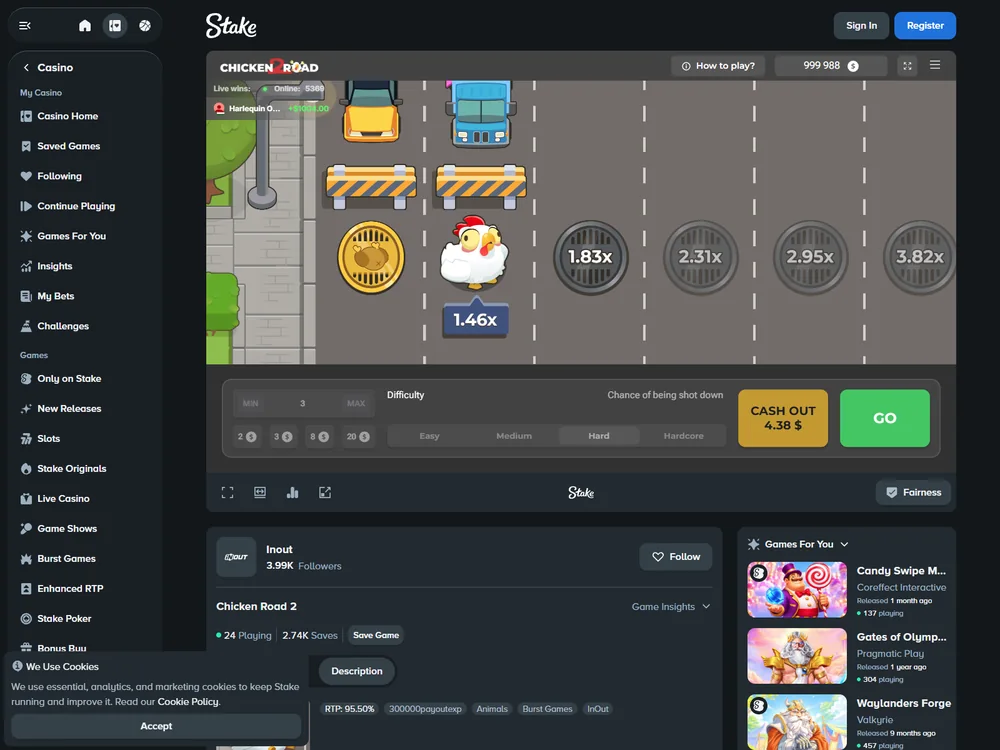
Options after a safe crossing - Check the final state before starting again. Use My bet history when the screen or balance leaves the result unclear. If you enabled the Space to spin & go setting, pressing Space sends a manual move command.
For anyone learning the Chicken Road 2.0 rules, how to play comes down to reading what the game has accepted. The number on the Cash out button at a safe position is a possible payout. Continuing replaces the offer after another safe step. A collision closes it.
Difficulty levels and lane multipliers
Harder roads have fewer lanes, greater risk on the transitions and higher potential multipliers. Each difficulty has its own sequence, so the same position can show different values on different roads.
Chicken Road 2.0 route lengths and first- and last-lane multipliers at 95.5% RTP
| Difficulty | Lanes | First multiplier | Last multiplier | First-lane gross on a 3 USD stake |
|---|---|---|---|---|
| Easy | 30 | 1.01× | 23.24× | 3.03 USD |
| Medium | 25 | 1.08× | 2,457× | 3.24 USD |
| Hard | 22 | 1.18× | 62,162.09× | 3.54 USD |
| Hardcore | 18 | 1.44× | 3,608,855.25× | 4.32 USD |
What changes from Easy to Hardcore
The lane count sets the end of your road. The original Chicken Road has 24, 22, 20 and 15 lanes from Easy to Hardcore. The table above applies to Chicken Road 2.0.
See the wider set of controls on the difficulty and features page.
How launch RTP affects the multiplier table
The operator and provider set the RTP profile at launch. The difference between 100% and the 95.5% profile is 4.5 percentage points before the cap. Separate 97% and 98% profiles use their own multiplier sequences. Selecting Hardcore changes the path inside your active profile. It leaves the profile itself in place.
At Hard lane 3, the 95.5% sequence offers 1.83× and the calculated probability of reaching that fixed exit is 52.19% before the cap. That figure describes a specific target. It does not tell you whether the next jump will succeed. See RTP, multipliers and probabilities for the full comparison.
How a round ends
A round ends on an accepted Cash out, a collision, the end of the selected road or a confirmed void. The order of events determines the result when a cash-out request and a collision occur close together.
What each round state means for your balance
| State | What happens in the round | Effect on the game balance |
|---|---|---|
| Play sent or rejected | The request has no accepted bet yet | No confirmed debit |
| Play accepted | One stake is committed to the chosen road | The stake is debited once |
| Safe Go | The chicken reaches the next valid lane | The new offer changes. No new stake is debited |
| Cash out accepted | The game fixes the accepted safe position | One gross payout is credited at settlement |
| Collision | The round closes with no payout if Cash out was still unconfirmed | No gross is credited |
| Road limit | The path ends when the selected road runs out of lanes | Use the confirmed settlement and apply the cap to any gross due |
| Confirmed void | The game records a cancelled result under the applicable rule | Check the refund entry and the resulting balance |
Accepted Cash out and collision
The accepted safe position supplies the multiplier for the payout. Check the settled entry to see which action the game accepted first. Read the final Win and Mult. fields together after the round closes. A round can end on a loss even when an earlier safe step showed a positive offer.
The end of the road and a confirmed void
Reaching the last lane ends the chain of available moves. The final lane has a multiplier in that road's table. The confirmed settlement records what is payable, and the launch applies its monetary cap to that calculation. The road position resets when the paid cycle ends.
A lost connection can leave the result temporarily unclear. The rules say that a malfunction voids pays and plays. Look for the server-confirmed state of your bet in My bet history. If the result is pending, wait for it to resolve before sending another Play.
Where to play Chicken Road 2.0
Compare six operator profiles. The scores reflect the routes tested for Chicken Road 2.0. Check authorisation in Poland and your account’s eligibility before depositing.
NV Casino

Cash test in PLN
- All 6 accepted rounds settled.
- Tested Visa deposit limits were 45.50–800 PLN.
- Withdrawals to a personal Visa started at 50 PLN.
Stake

Poland restriction
- Terms §14.3 exclude Poland.
- No cash bets were accepted in the Polish account.
- The 63 PLN transfer was still under review at the end of the test.
Total Casino

Signed-in PLN test
- All 5 accepted rounds settled.
- Public search found no exact InOut title.
- Tested BLIK deposit limits were 10–600 PLN.
Ice Casino

Cash test in PLN
- 5 of 6 accepted rounds settled. One was voided.
- Tested Skrill deposit limits were 40.50–700 PLN.
- The demo opened from the operator’s own game listing.
Bison Casino

Poland restriction
- The eligibility prompt required access from outside Poland.
- The virtual demo ran separately from the cash account.
- The 79.15 PLN BLIK payment was still under review at the end of the test.
Mostbet

Cash test in EUR
- All 7 accepted rounds settled in the EUR wallet.
- Standard Chicken Road 2.0 was listed as card 123628.
- Tested Mastercard deposit limits were 18.25–390 EUR.
How settlement changes your balance
The game multiplies your stake by the accepted multiplier, applies the payout cap and rounds the resulting gross to the wallet's monetary increment. Settlement credits that gross to the in-game balance. An external transfer requires a separate request through the operator.
Gross payout, net result and rounding
Gross is the full amount credited for the bet. To read your net result on a settled round, subtract the original stake from that gross. The stake was debited at acceptance, so you can also compare the balance before Play with the balance after settlement. If you compare from the post-debit balance instead, the increase you see is the gross.
I checked this sequence on a Hard round at NV Casino using a PLN wallet. The game accepted 3.55 PLN and the balance after debit was 91.65 PLN. I stopped after lane 2, and the game accepted 1.46×. The product of 3.55 and 1.46 is 5.183 PLN. That stayed below the cap and rounded to 5.18 PLN, so the balance rose to 96.83 PLN. The net gain was 1.63 PLN. From acceptance to settlement, the round took 16 seconds.
The accepted multiplier applies once. Suppose you see 4.38 USD after Hard lane 2 on the 3 USD demo stake and select Go. If the next crossing succeeds, 5.49 USD replaces the previous offer. A cash out accepted on lane 3 would use 5.49 USD as the gross, subject to the demo's cap. The two offers are values of the same bet at different positions.
A loss leaves the stake debited. In another NV Casino round, I selected Medium and staked 3.55 PLN. The first lane carried a 1.08× offer if reached, but the chicken collided before completing that crossing. The payout was 0.00 PLN and the balance stayed at 93.28 PLN after the debit.
A void can show zero payout even when the stake comes back. In one Ice Casino round, my 4.60 PLN stake was already accepted when the connection dropped. After returning to the session, I checked the history. The game recorded a void and returned 4.60 PLN, taking the balance from 108.18 PLN after debit to 112.78 PLN. The final history contained one void for the bet. I sent no second Play. Treat the returned stake as a refund when you reconcile the balance.
Game limits by wallet and launch
Use the cap shown in the game you are playing. In the InOut demo, a 3 USD stake starts to hit the 20,000 USD cap at about 6,666.67×. At the last Hardcore lane, 3 USD multiplied by 3,608,855.25 gives 10,826,565.75 USD before the cap. After the cap, the calculation yields 20,000.00 USD in virtual demo funds.
Before committing money, there are two questions to resolve about Chicken Road: how to play the round and how much the game allows you to stake or receive in your wallet. The limits below belong to specific launch and wallet combinations. Use the Game rules shown in your session for the applicable numbers.
Stake limits and payout caps by launch
| Launch | Market or mode | Wallet | Stake range | Cap per paid round |
|---|---|---|---|---|
| InOut | Demo | Virtual USD | 0.12–200 USD | 20,000 USD |
| NV Casino | Poland | PLN | 0.55–56.00 PLN | 24,500 PLN |
| Total Casino | Poland | PLN | 0.60–62.25 PLN | 23,250 PLN |
| Ice Casino | Poland | PLN | 0.64–56.75 PLN | 26,875 PLN |
| Mostbet | Poland | EUR | 0.41–35.75 EUR | 13,750 EUR |
| 22bet | Finland | EUR | 0.32–36.75 EUR | 13,625 EUR |
| Bitguruz | Finland | EUR | 0.21–35.25 EUR | 11,750 EUR |
The Polish cash sessions shown in the table use the stated PLN or EUR wallet. The Finnish rows describe separate launch profiles, and the USD demo runs on virtual funds. In the Polish Stake and Bison Casino sessions the paid round was unavailable, so there is no cash stake or payout cap to apply to those sessions.
The cap in Game rules applies to one payout. A withdrawal has separate account conditions and limits set by the operator. If the game has already settled and you want to move the money to a card, bank account or another payment instrument, see how external withdrawals work.
Check My bet history and the Bet ID
Open My bet history to check the accepted bet and its result. Date helps you find the row, Bet is the amount committed, Mult. shows the multiplier recorded for the outcome, and Win shows the gross. Open the details for the Bet ID if you need the exact record. Compare it with the balance movement for that round.
The useful sequence is acceptance, debit, result and settlement. On a win, the balance increase from settlement should match the gross. On a collision, there is no gross to add. If a void includes a refund, compare the returned stake separately. When several rounds are close together, use the Bet ID to identify the relevant one.
The InOut client keeps the rules and bet history in separate menus. Use the rules to check what you are agreeing to before Play and the history to check what the accepted bet produced. If you are learning how to play Chicken Road 2.0, try the controls on a virtual balance in the official demo. This route uses manual Play, Go and Cash out, with no active autoplay, autobet or automatic cash out. The base round has no separate bonus game, internal free spins, respins, Bonus Buy, ante or progressive jackpot. Operator bonus terms apply separately from the paid round.
Frequently asked questions
Does Go place another bet?
No. The amount committed at Play covers the whole accepted round. Go advances the same attempt to the next lane without an additional debit.
When can I cash out?
You can request Cash out after a confirmed safe crossing. The offer becomes payable when the game accepts the request. If the collision comes first, the round closes with no payout.
What happens when I reach the last lane?
The road ends at the last lane for your selected difficulty. Look at the confirmed settlement for the round outcome. The launch's payout cap still applies to any gross due.
Does changing difficulty change RTP?
The difficulty selects one of the four roads within the active RTP profile. Launch settings determine whether the game uses the 95.5%, 97% or 98% profile described here.
What should I check if the connection drops?
Check My bet history for the Bet ID and the settled or void status. Wait while the outcome is pending. A confirmed void with a refund returns the stake, as in the 4.60 PLN Ice Casino example.
Does Cash out send money to my bank?
Cash out credits a settled payout to the game balance. To move money to an external payment instrument, submit a withdrawal through the operator and follow its account conditions.

Author
Publisher information
Chicken Road is an informational website published by Michał Kowalski. Casino operators manage player accounts, accept wagers and process deposits and withdrawals.
Play responsibly
18+. Gambling can cause financial and personal harm. Set limits on time and spending before you play. For support, see GamCare and GambleAware.