



Chicken Road 2.0 Provably Fair Before and After a Round
Before Play, the client gives you a commitment to the next server seed. Once the bet settles, history gives you the inputs and output you need to compare.
The Server Seed Commitment
Open Provably fair settings before the round to find Next server seed SHA256. SHA-256 produces a fixed-length fingerprint from the seed. The game reveals the fingerprint first and the server seed later. Once you have both, hashing the revealed seed and comparing the result lets you check that the same seed was committed in advance.
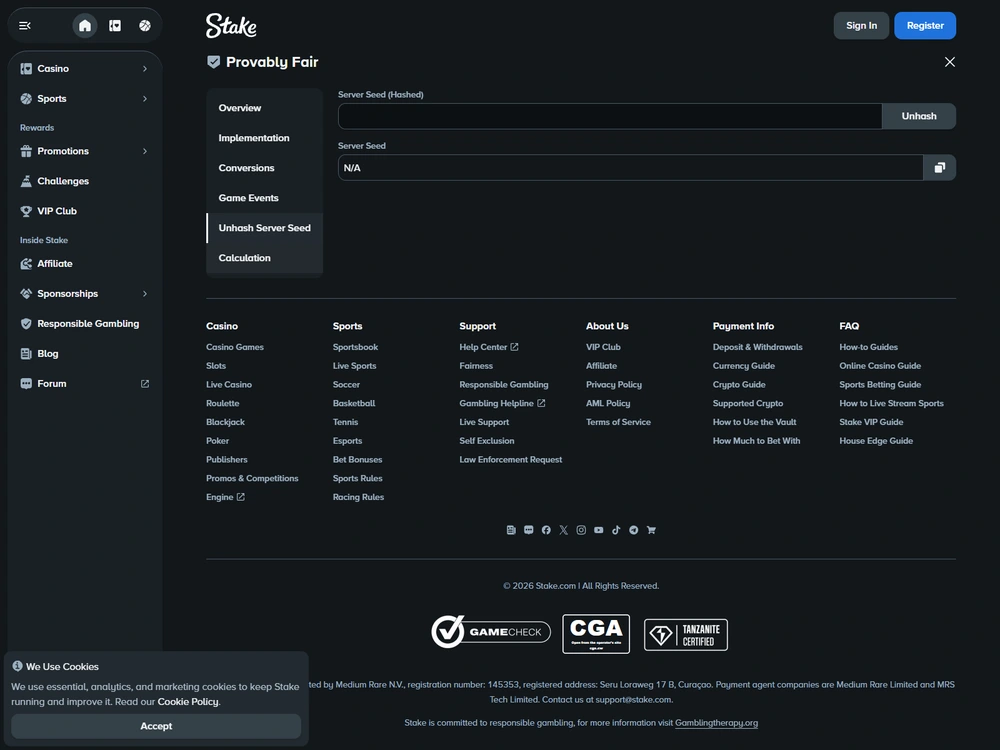
The settings also show Next client (Your) seed, Random on every game and the current client seed. The window allows you to copy the values. Save the complete fingerprint, including every character, while it applies to the round you mean to follow. The field refers to the next server seed, so opening it after settlement can give you a different commitment.
What Bet History Reveals
Once the bet settles, My bet history lists Date, Bet, Mult. and Win. The detail view separates what was staked and credited from the inputs to the result. The client describes the result as a combination of the server seed and the “first 3 bets of the round”. That wording belongs to the settings window. Use the disclosed inputs and the rules for your selected round to replay it.
| Field | What to check |
|---|---|
Bet ID, Player |
Match the chosen record to the round and player before comparing values. |
Bet, Win, Result |
Read the accepted stake, the recorded credit and the outcome as separate fields. |
Client Seed, Server Seed |
Read the revealed inputs. Use the server seed to check the earlier SHA-256 commitment. |
Combined SHA512 Hash |
Compare the complete digest when replaying the result with the applicable inputs. |
Hex, Decimal |
Compare the reported representations when you trace the calculation from hash to number. |
How to Verify a Settled Round
Begin with one Bet ID and the commitment you saved for its round. Keep the result check and the balance check tied to that record.
Match the Bet ID and Revealed Inputs
For Chicken Road 2.0 Provably Fair result verification, keep the advance commitment, the settled bet details and the applicable game rules together. That gives you three comparisons with separate purposes. The commitment ties the server seed to its earlier fingerprint. The combined digest checks the supplied inputs. The result conversion checks the reported outcome against the rules.
- Keep the advance commitment. Open
Provably fair settingsand copyNext server seed SHA256before the relevant round. Keep it with the context of that round. A hash from the settings view for a later round represents a different comparison. - Find the settled record. Go to
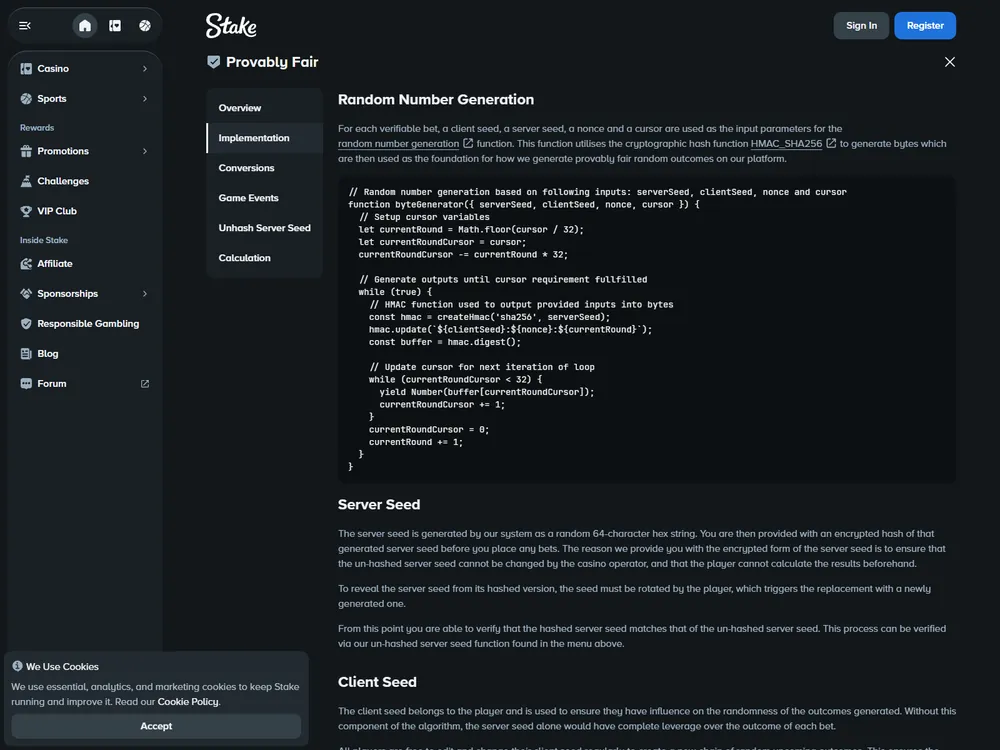
My bet historyand open the matchingBet ID. Confirm the player, stake and result before collecting both seed fields,Combined SHA512 Hash,HexandDecimal. - Compare the commitment. Compute SHA-256 using the revealed server seed in the format required by the round's rules. Compare the complete value with the commitment you kept. A match links the revealed seed to that earlier fingerprint.
- Check the result. Use the input order, byte format and conversion applicable to that round. Compare the full SHA-512 digest, then compare the resulting number and game outcome. If you kept only the bet record, you can still read its disclosed inputs and settlement, while the advance comparison requires the corresponding commitment.
- Read the settlement separately. Match the accepted multiplier to the stake and the credit recorded for the same Bet ID. Use the applicable payout cap and monetary rounding. If the session dropped, reopen history and check the final status before interpreting the displayed rows.
Chicken Road 2.0 is a single-player step game. One accepted Play starts the paid round, Go continues it, and an accepted Cash out settles it at the reached multiplier. A collision ends the round with zero payout. Reaching the last lane also ends the paid cycle. A confirmed void has its own status and can return the stake. These distinctions tell you whether a number in the record is a payout or a refund.
Read the multiplier from the accepted result. The grid shows the value available at a step, while an accepted result identifies where the round actually ended. The applicable rules use the maximum win when the stake multiplied by the cash-out coefficient exceeds the cap. For the provider's USD demo, the minimum and maximum stakes are 0.12 USD and 200 USD, and the maximum win per paid round is 20,000 USD.
If the details differ, start by checking the Bet ID, the applicable configuration and the copied values. An input mismatch, a different game profile and a difference in the credited amount call for different follow-up. Check the game version if the provider or title shown in your client differs.
Reconcile the PLN Settlement
In the Polish NV Casino example CR2-NV-R01, I checked the settlement after the 3.55 PLN stake was accepted. The round closed on Hard 2 at 1.46×, 16 seconds after acceptance. The product of 3.55 PLN and 1.46 is 5.183 PLN, which rounds to the credited 5.18 PLN. After subtracting the original stake, the net result is 1.63 PLN.
The balance after the debit was 91.65 PLN. Adding the 5.18 PLN credit gives 96.83 PLN, the balance after settlement. When you start from the opening balance, subtract the debit and add any gross payout and refund. When you start from the balance after debit, add the credit once. Both readings describe the same ledger movement.
Ice R04 shows how to read a different final state. Connection dropped after the bet was accepted. After sign-in, history showed one void with a 4.60 PLN stake return. The duplicate display cleared and the balance stayed the same. For an interrupted round, use the final status and the balance together before counting a refund.
Keep the wallet currency attached to its own case. The PLN credit above belongs to the NV round in Poland. The provider's USD demo and other operator profiles have their own rules for stakes and payout caps. Any later withdrawal from a PLN wallet has a separate record in the operator's cashier.
Where to play Chicken Road 2.0
Compare six operator profiles. The scores reflect the routes tested for Chicken Road 2.0. Check authorisation in Poland and your account’s eligibility before depositing.
NV Casino

Cash test in PLN
- All 6 accepted rounds settled.
- Tested Visa deposit limits were 45.50–800 PLN.
- Withdrawals to a personal Visa started at 50 PLN.
Stake

Poland restriction
- Terms §14.3 exclude Poland.
- No cash bets were accepted in the Polish account.
- The 63 PLN transfer was still under review at the end of the test.
Total Casino

Signed-in PLN test
- All 5 accepted rounds settled.
- Public search found no exact InOut title.
- Tested BLIK deposit limits were 10–600 PLN.
Ice Casino

Cash test in PLN
- 5 of 6 accepted rounds settled. One was voided.
- Tested Skrill deposit limits were 40.50–700 PLN.
- The demo opened from the operator’s own game listing.
Bison Casino

Poland restriction
- The eligibility prompt required access from outside Poland.
- The virtual demo ran separately from the cash account.
- The 79.15 PLN BLIK payment was still under review at the end of the test.
Mostbet

Cash test in EUR
- All 7 accepted rounds settled in the EUR wallet.
- Standard Chicken Road 2.0 was listed as card 123628.
- Tested Mastercard deposit limits were 18.25–390 EUR.
PF-CR2-T01 and the Hard 3 Result
The control calculation reaches Hard 3 at 1.83× because the number extracted from its SHA-512 digest falls below the Hard 3 threshold.
Replay the Exact UTF-8 Input
PF-CR2-T01 is a control vector with a known outcome. First, hash only the server seed to check its SHA-256 commitment. Then build the second input by putting the server seed, the three client seeds and the nonce in the order shown below. Hash that complete input with SHA-512. The two comparisons use different inputs and different digest lengths.
| Field | Value |
|---|---|
| Server seed | cr2-training-server-2026-11 |
| Client seeds in order | client-a, client-b, client-c |
| Nonce | Decimal string 17 |
| Encoding and separator | UTF-8, literal vertical bars, no trailing LF |
| SHA-256 of the server seed | ce891719b7abed3a69ac5973c46d68e6d49fb858ea8e184c84ec3e7b18f00d3d |
| SHA-512 of the complete input | 51fd7cd05a72f256664dd4d7d69470ec2748f5054e10aecc9eeb97e1594720c5f6cf867080cc90f2819763ec5de3c3c57c025e1201e5f59bf3273e3ea858935d |
| Selected hex prefix | 51fd7cd05a72f, the first 13 hex digits |
| Integer and normalised value | 1442386601682735 ÷ 16¹³ gives u = 0.32027416, rounded |
| Hard 3 threshold and result | u < 0.521858, so Hard 3 is reached at 1.83×. The outcome if the round ends before the target is 0. |
Copy the following as a single line. Its separators are literal vertical bars. Feed UTF-8 bytes to SHA-512 without a trailing line feed, carriage return, byte-order mark or surrounding spaces. If your tool automatically adds a newline when it reads text, remove that extra byte before comparing the digest.
cr2-training-server-2026-11|client-a|client-b|client-c|17
Convert the Digest to a Result
The first 13 hexadecimal digits give a non-negative integer. Dividing by 16¹³ scales the integer to a number from zero up to, but below, one. Here the result is approximately 0.32027416, below the Hard 3 success threshold of 52.1858%. The value falls on the side that reaches the target, at 1.83×. The complementary probability for ending before the target is 47.8142%.
Use the full digest for the hash comparison and the prefix only for the conversion. The prefix selects the numeric input to this control calculation. The complete digest gives you a stronger comparison of the encoded input. Even a small change, such as swapping two client seeds or hashing the newline, changes what you feed into SHA-512.
The threshold belongs to the 95.5% profile used for this example. The 97% and 98% versions are separate RTP profiles. Difficulty is selected before Play and sets the lane layout and step targets. For the relationship between a target multiplier and its probability, see RTP and multiplier maths.
InOut's revealed inputs and the applicable game rules were also used to check a specific server bet. PF-CR2-T01 supplies a fixed set of bytes to practise the same kinds of comparison. When you check a live round from history, use its own seed values, ordering and rules.
What the Game Configuration Certificate Covers
Chicken Road 2.0 has a certificate for its game configuration. A separate B2B licence, ALSI-202506032-FI2, covers the supplier IOGr B.V. in Anjouan. Gamecheck checked a sample of games for authenticity. The Bitguruz SEAL marks continuous monitoring for authenticity. For an individual round, the evidence is the commitment, revealed inputs and resulting record.

For play in Poland, use the legal and licensing context for the operator and market. If a service claims to turn a public commitment into a forecast, see predictors and signals for what those claims require.
Start with the control line to check your hash tool. Then use the advance commitment and the settled Bet ID to verify the round you recorded. Check any wallet credit against that same record. See the verification method for how these checks fit into the wider testing process.
FAQ
Can the next server seed hash predict a Chicken Road 2.0 round?
The advance hash cannot predict the outcome of a future round. Once the server seed is revealed, hash it and compare the result with the commitment you saved.
Does a matching multiplier verify my round?
A matching multiplier checks one part of the outcome. To verify the round, compare the advance commitment and the revealed seed, then compare the full digest and its conversion under the applicable rules.
Does the configuration certificate verify my bet or withdrawal?
The certificate covers the game configuration. To verify a bet, use that round's record and revealed inputs. To check a withdrawal, use the operator's separate cashier record.
Which amount should I check in a PLN wallet?
Compare Win with the gross amount credited for the same Bet ID. In the NV example, 5.18 PLN was credited and 1.63 PLN was the net result after the 3.55 PLN stake.

Author
Publisher information
Chicken Road is an informational website published by Michał Kowalski. Casino operators manage player accounts, accept wagers and process deposits and withdrawals.
Play responsibly
18+. Gambling can cause financial and personal harm. Set limits on time and spending before you play. For support, see GamCare and GambleAware.